What Keeps Drawing You Back to the Same Small Room
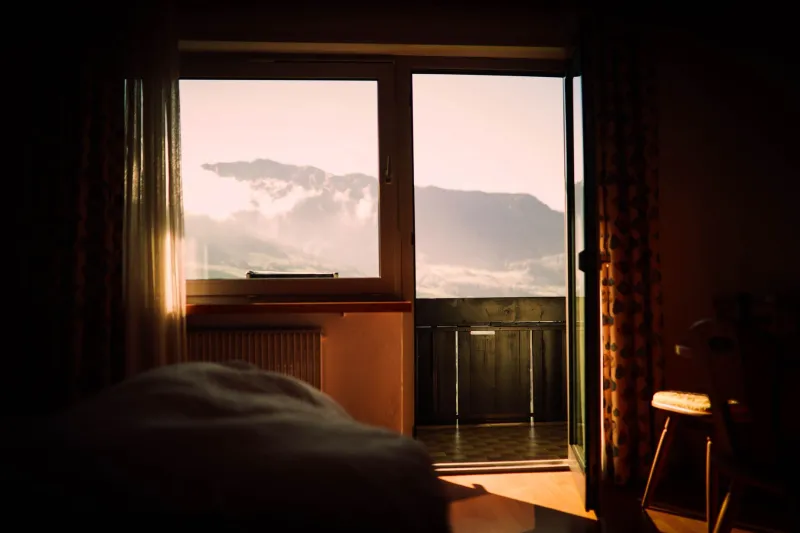
There's a room in a small Montana mountain town — two double beds, a window unit, a painting of a elk that's been hanging slightly crooked since at least 2009 — that a retired schoolteacher named Donna has booked every September for eleven years running. She doesn't come for the hiking anymore, she admits. She's not sure she ever really did.
"The first time I came, I thought I needed the mountains," she says. "By the third or fourth year, I realized I needed the room."
Donna's not unusual. Talk to any small-town motel owner who's been at it long enough, and they'll tell you about their regulars — the ones who don't need to be shown to their room, who bring the same worn paperback every time, who sit in the same chair by the window and stare at the same patch of sky. These guests aren't here for novelty. They're here for something harder to name.
The Stillness You Can't Buy at a Resort
Big-ticket travel is engineered to keep you occupied. There's always a spa treatment to book, a guided excursion to join, a happy hour starting in twenty minutes. The industry runs on the fear that a guest left alone with their thoughts is a dissatisfied guest. Small-town motels don't have that problem — or that budget. What they offer instead, often accidentally, is something closer to silence.
Dr. Mara Ellison, a licensed therapist based in Bozeman who works with clients dealing with burnout and life transitions, says that kind of enforced quiet can be genuinely therapeutic — and genuinely unsettling.
"When people remove the usual distractions — the commute, the notifications, the social obligations — unresolved things tend to rise to the surface," she explains. "It's not always comfortable. But a lot of people find that they need that discomfort. They've been outrunning it for months, sometimes years."
The modest motel room, with its limited square footage and zero programming, creates what Ellison calls "low-stimulation containment." You can't really hide in it. You can watch TV, sure, but at some point the TV stops working or you stop caring, and then it's just you and whatever you brought with you — including the stuff you didn't mean to pack.
Why the Same Room, Year After Year
The ritual loyalty that some guests develop toward a particular motel room is worth taking seriously. It's not inertia. These are people who make deliberate choices to return to a specific place, often at the same time of year, often staying the same number of nights. That's not habit. That's something closer to pilgrimage.
Randy, a contractor from outside Denver who's been stopping at the same two-lane highway motel in southern Montana every spring for eight years, puts it plainly: "I go through a lot of change in my life. Job stuff, family stuff. That room doesn't change. The same ugly carpet, the same weird lamp. I know exactly what it's going to look like when I open the door. There's something about that I can't explain but I can't give up either."
What Randy's describing has a name in psychology: it's sometimes called an "anchor experience" — a recurring event or place that provides a stable reference point when the rest of life feels unstable. Therapists often see clients unconsciously create these anchors without realizing it. The annual fishing trip. The same diner booth every Sunday. The motel room with the crooked elk painting.
"Anchor points aren't about nostalgia," Ellison clarifies. "They're about orientation. When everything else is shifting, having a fixed point helps people locate themselves. It's a way of asking: who was I last time I was here, and who am I now?"
The Questions That Surface After Dark
Most regulars will tell you the real work happens at night. Not during the hike or the drive through town or the diner breakfast — those are pleasant enough. But somewhere around 10 p.m., when the room gets quiet and the parking lot outside goes still, things start to come up.
Donna says she keeps a journal specifically for her September trips. "I've written things in that room that I couldn't write at home. I don't know why. Maybe because home has too much history in it. The motel room is neutral territory. It doesn't know me."
That neutrality matters more than it sounds. Home environments are loaded with associations — the chair where you had that argument, the kitchen where you got the bad news, the bed where you spent too many nights not sleeping. A plain motel room carries none of that freight. It's a clean slate, which makes it easier to think clearly, or honestly, or both.
Some guests describe arriving with a specific question they haven't been able to answer — whether to leave a job, end a relationship, move across the country — and leaving with something that feels like clarity. Not always the answer they expected. Sometimes just the willingness to sit with the question a little longer.
What Small-Town Motels Understand That Big Hospitality Doesn't
There's an accidental wisdom built into places like this. The owners of small independent motels — the ones that have been running for thirty or forty years, that haven't been bought out or rebranded — tend to have a feel for what their guests actually need, even when the guests themselves don't know.
"People don't always come here for what they say they're coming for," says one motel owner in western Montana who asked not to be named. "They say they're here to fish or to drive the pass. And maybe they do those things. But I've had guests check in for two nights and stay for a week. Something's happening for them here. I don't ask. I just make sure the coffee's ready in the morning."
That instinct — to provide comfort without intrusion, to be present without hovering — is something the hospitality industry has largely optimized away. It's hard to monetize. It doesn't show up in a review as a specific amenity. But it's real, and the people who need it tend to find their way to places that still offer it.
Coming Back to Come Back to Yourself
If you've ever felt the pull toward a particular modest place — a roadside motel, a mountain-town inn, a room you could describe from memory even though you haven't been there in years — it might be worth paying attention to that pull. Not as nostalgia. As information.
What you're being drawn back to probably isn't the room itself. It's the version of yourself that showed up there last time. The one who was quiet enough to hear something. The one who had, briefly, nowhere else to be.
Donna's already got her September reservation in. Same room, if they can manage it. Same crooked elk.
"I go to find out what I've been avoiding," she says, and she doesn't sound troubled by it at all. "Every year it's something different. That's how I know I'm still figuring things out. That feels like enough."