Staying in the Past on Purpose: What Old-School Motels Know About America That New Hotels Have Forgotten
Walk into the right motel room in the right small town, and something shifts. The bedspread has a pattern you haven't seen since your grandmother's house. The dresser is solid wood, the kind they don't bother making anymore. A rotary-style lamp sits on the nightstand, and the window unit hums at a frequency that feels almost nostalgic. You're not in a boutique hotel curated to look vintage. You're in a place that simply never stopped being itself.
That distinction matters more than it might seem.
The Difference Between Preserved and Neglected
There's a version of the "old motel" story that reads as sad — peeling paint, broken ice machines, carpet that's seen too many decades. But that's not what we're talking about here. Across small towns and mountain communities throughout the American West and beyond, there are motel owners who have made a deliberate choice: keep the bones, maintain the integrity, resist the pressure to renovate into something generic.
Sherry Aldecoa has run a 14-room motel in a small Montana valley town for going on 22 years. She inherited it from her aunt, who built it in the early 1960s. The knotty pine paneling is original. So is the turquoise tile in three of the bathrooms. Sherry has replaced plumbing, updated the electrical, and put in new mattresses twice over — but she hasn't touched the aesthetic.
"People come in and they just stop," she says. "They stand in the doorway and they go quiet for a second. I think it takes them somewhere. I'm not sure where, exactly — maybe somewhere they've been before, or maybe somewhere they always imagined going. Either way, I'm not going to rip that out to put in a subway tile backsplash."
She laughs when she says it, but she means it.
What the Room Is Actually Telling You
A well-preserved motel room isn't just aesthetically interesting. It's a document. The materials, the layout, the color palette — all of it reflects the era in which it was built and the community it was built to serve.
Mid-century American motel design wasn't accidental. It was optimistic. Post-war prosperity meant more families had cars, and the open road became a symbol of freedom and possibility. Motels were built to welcome people who were going somewhere — families on vacation, salesmen covering territory, couples on their first road trip together. The rooms were modest but proud. Comfortable but not fussy. The design said: you're welcome here, and this place is worth stopping for.
That message is still embedded in the architecture, if you pay attention.
In towns that have held onto their original lodging stock, you get a clearer sense of who the community was trying to be when those buildings went up. A motel in a logging town built in 1958 tells a different story than one in a ranching community from the same era. The local stone used in the lobby, the mural painted by a regional artist above the check-in desk, the name on the sign — all of it is local history made physical.
The Owners Who See Themselves as Stewards
Not every vintage motel owner thinks of themselves as a preservationist. But spend enough time talking to the people who run these places, and a common thread emerges: they feel responsible for something larger than room occupancy rates.
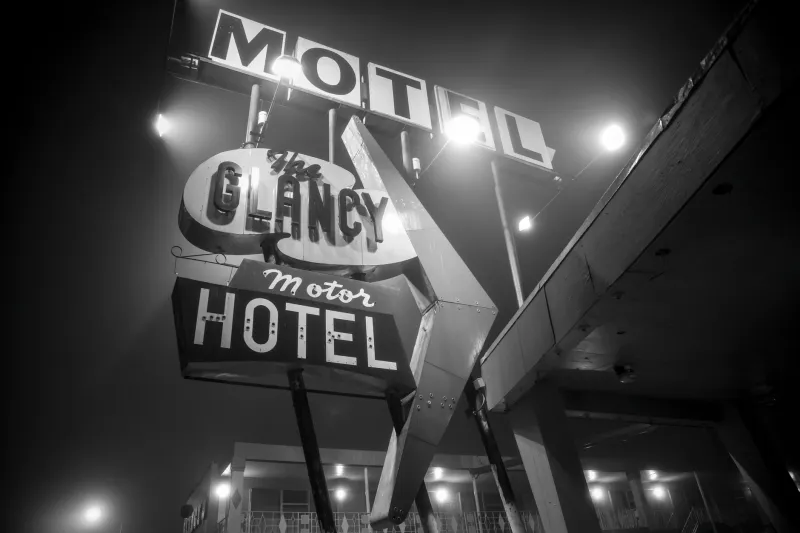
Dave Kostrowski took over his family's motel in a small Wyoming town after his father passed. The property was built in 1955 and still has its original neon sign — a rearing horse in pink and white that lights up the main road every night at dusk. Dave had a sign company offer to replace it with something LED and modern. He turned them down without much deliberation.
"That sign is the first thing people see when they come into town from the west," he says. "It's been there longer than most of the people who live here now. You don't just swap that out because it's easier to maintain."
He's not precious about everything — he'll update what needs updating, fix what breaks, make sure guests are comfortable. But there's a line he won't cross, and it runs roughly along the boundary between function and identity.
"The room works fine. The town has a history. Those two things should be able to coexist."
Why Budget Travelers Are the Ones Who Find This
Here's something worth noting: the travelers most likely to stumble into these places aren't the ones booking luxury mountain retreats. They're the ones who are watching their spending, taking the road less algorithmically recommended, and choosing a $75 room over a $250 one without much agonizing.
And in doing so, they often end up somewhere more interesting.
The high-end resort experience is carefully controlled. Everything has been selected, styled, and optimized for a particular kind of satisfaction. There's nothing wrong with that — but it doesn't leave much room for surprise, or for genuine encounter with a place's actual character.
A small-town motel that has been running since your parents were young doesn't have a brand consultant. It has a history. And if the owner has taken care of the place, that history is right there in the room with you — in the tile, the trim, the view out the window toward the same mountain range that travelers have been looking at since the place opened.
What You Take With You
People talk about travel as a way to learn about the world, but the most useful kind of learning often happens sideways — not from a tour guide or a plaque on a wall, but from noticing things. The way a room is laid out. The weight of a door handle. The particular shade of green someone chose for the exterior trim in 1962 and never saw a reason to change.
Small-town motels that have resisted the pressure to modernize aren't offering you a theme park version of the past. They're offering you the actual past, maintained and functional and available for $70 a night.
That's not a small thing. In a travel landscape increasingly defined by sameness — the same finishes, the same fonts, the same curated local honey on the welcome tray — a room that has simply been itself for sixty years is a genuine rarity.
Stay in one long enough, and you start to understand something about the town it sits in. About the people who built it, the travelers who passed through, and the family that kept the lights on through every economic shift and changing fashion in between.
That's not nostalgia. That's history you can sleep in.